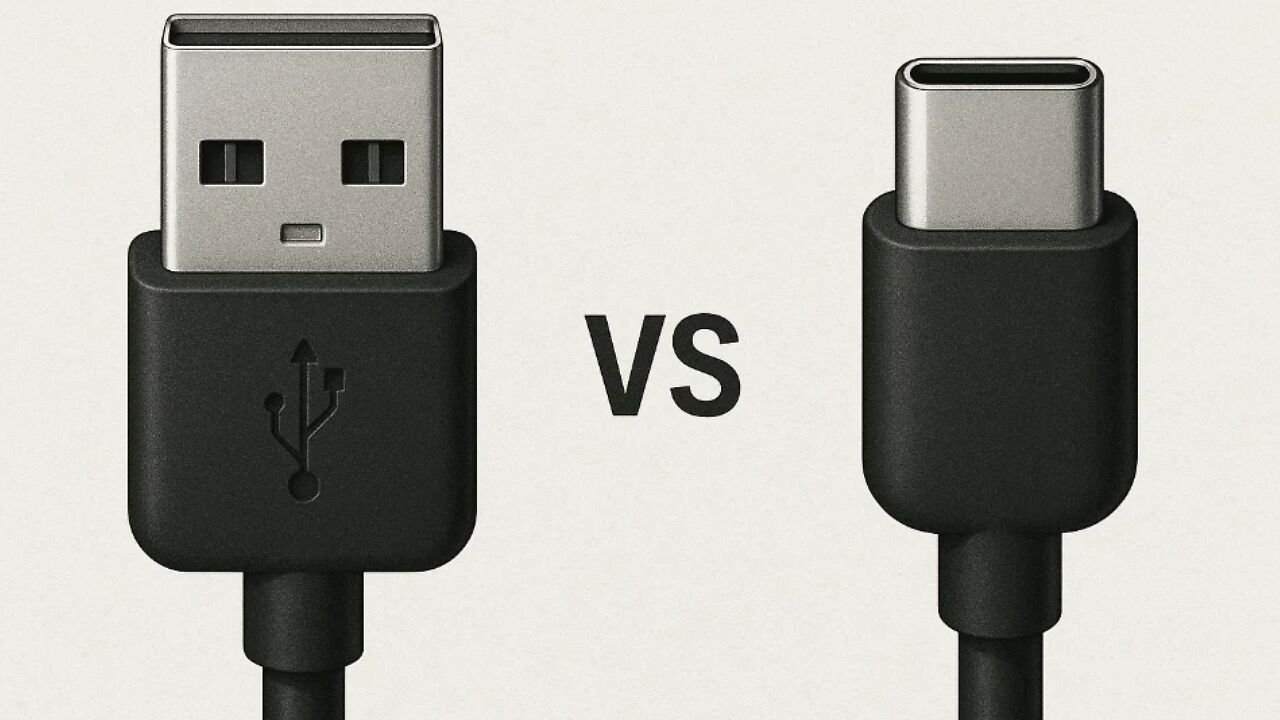
In today's digital and smartphone era, charging cables and ports have become an essential part of our daily lives. Whenever we buy a new phone, laptop or charger, the two most common names we often come across are USB Type-A and USB Type-C. Although the primary function of both is to power the device and transfer data, there is a huge difference in their internal technology, design and functionality.
USB Type-A is the traditional, square and rectangular port we've seen on desktop computers, older laptops, TVs, car music systems, and common charger adapters for decades. The biggest limitation of Type-A is that it comes with a one-directional design, meaning it can only be plugged in one direction. Installing the cable in the wrong direction often risks breaking or loosening the pins inside the port.
On the other hand, USB Type-C is a modern, oval and extremely compact connector that has revolutionized the global tech industry. The biggest attraction of the Type-C port is its reversible design, which means whether you connect the cable straight or upside down, it fits instantly without any obstruction. Additionally, Type-C ports have 24 pins of advanced circuitry, while older Type-A ports typically only have 4 to 9 pins. This is why Type-C is not only light and thin, but has also become the most suitable port for modern slim smartphones, tablets and ultrabooks.
When it comes to charging smartphones in a jiffy, USB Type-C leaves its old rival USB Type-A far behind. The main reason for this is the 'USB Power Delivery' (USB-PD) protocol that works with USB-C.
The technical limitations of traditional USB Type-A ports are quite limited. Generally Type-A port can supply maximum power up to 5V and 2.4A (about 12W). Although some brands like Xiaomi, Oppo or Realme can send up to 33W or 65W of power through Type-A cable through their customized protocols (like Quick Charge or Dart Charge), this is not a universal standard and requires special hardware.
In contrast, USB Type-C is designed from the ground up to handle huge power outputs. The Type-C port can easily deliver up to 100 watts (20V/5A) of power under standard USB-PD technology, and with the new USB PD 3.1 standards this capacity reaches 240 watts. This simply means that the Type-C port can not only charge your smartphone superfast in 15 to 30 minutes, but with this single cable you can also power heavy gaming laptops, tablets, cameras and drones at full speed.
The question that often arises in the minds of consumers is whether very fast charging spoils the phone's battery quickly, and in this case which option between Type-A and Type-C is safe for battery life. From a technical point of view, USB Type-C proves to be a much safer and smarter option for the battery life of smartphones.
Type-C is not just a simple wire to send power, but it establishes a two-way handshake between the charger and the phone. The included smart chipset with USB Type-C and PD charging monitors the phone's temperature, battery current level and voltage in real-time. For example, when the phone's battery is between 0 and 50 percent, Type-C sends current at maximum watts. As the battery reaches 80 percent and starts to heat up, the Type-C's intelligent circuit slows down the current (trickle charging), thereby eliminating overheating and chemical stress on the battery.
On the other hand, older Type-A ports have limited capabilities for temperature and smart voltage modulation. If a cheap or non-standard Type-A adapter is used, it may not have adequate technology to prevent sudden voltage fluctuations, increasing the risk of premature battery discharge or failure. So USB Type-C is completely a step forward in terms of long-term battery safety and stability.
Apart from power and charging, the difference between the two in data transfer speed is also shocking. The maximum data transfer speed on traditional USB Type-A ports (especially USB 2.0) is limited to only 480 Mbps. If you are copying a heavy video file of 10 GB from PC to phone, it takes several minutes.
In contrast, USB Type-C ports fully support modern USB 3.2, USB4, and Thunderbolt 3/4 protocols. Through this, data can be transferred at ultra-fast speeds of 10 Gbps, 20 Gbps and up to 40 Gbps with Thunderbolt. That means huge data of gigabytes is transferred in just a few seconds.
Not only this, USB Type-C is multi-functional. It's not just limited to charging and data, but with the help of 'DisplayPort Alternate Mode' you can directly mirror or cast your phone or laptop screen to a 4K or 8K monitor through a single Type-C cable. After the European Union (EU) and the Indian government made 'universal common charger' (Type-C) mandatory for all smart gadgets, the future now completely belongs to Type-C. If you want fast charging, durable battery health and hassle-free connectivity for your smartphone, then USB Type-C is the best choice on all counts.