
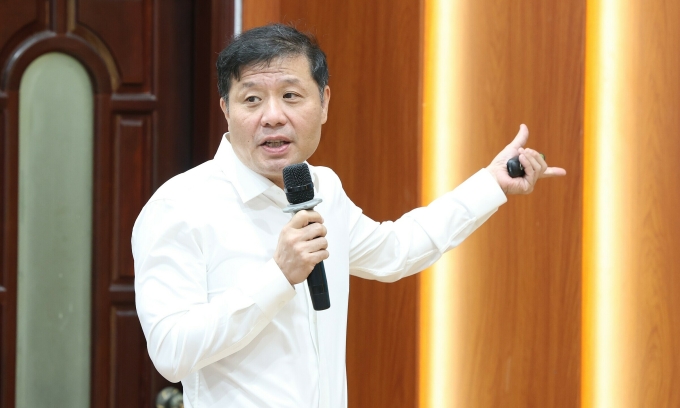
Vietnamese mathematician who left Yale for Hong Kong says most students study math just to get through it

Professor Van, who joined the University of Hong Kong’s Department of Mathematics this year after a long tenure at Yale and continues to lead Vietnam’s Vingroup Innovation Foundation (VinIF), made the remarks on April 13 at a seminar on teaching mathematics in the technology era hosted by Vietnam National University, Ho Chi Minh City.
He blamed sprawling curricula and decades-old teaching methods for producing graduates who score well in math but cannot apply it.
“Most students still study math to pass the course, to cope,” he said. “Even at U.S. universities, the majority of students approach math with this mindset.”
Professor Vu Ha Van speaks about teaching and learning mathematics at the seminar in Ho Chi Minh City on April 13, 2026. Photo by Khac Hieu |
Van illustrated the disconnect with a story about a visit to a dentist in the U.S. who, on learning he was a math professor, asked: “What’s the point of studying math? Math has sines and cosines, but I’ve never used them in my work.” He said he hears similar complaints constantly about integrals and derivatives, material people cannot connect to anything in their daily lives.
The problem, he argued, is not mathematics itself but how it is taught. School and university math programs are stuffed with content that has no link to real-world technology or industry.
“Some theories take months for students to grasp. But to be fair, unless you end up working at NASA, you’ll probably never use them,” he said. “Meanwhile, in everyday life there are real needs tied to basic math. Financial investing, for instance, requires understanding variance theory, but most people only have a vague grasp of it.”
The same paradox plays out in industries that supposedly demand high-level mathematics. Van pointed to recruitment for VinIF’s AI engineering program, which draws candidates from math-related majors at top Vietnamese universities such as Hanoi University of Science and Technology and the University of Science. Despite high grades, most new hires need around four months of remedial work in foundational subjects before they can do the job.
He framed mathematics as something far broader than formulas, a way of thinking and seeing how the world works, and compared the discipline to sports. Everyone benefits from physical activity, he said, but the question is which sport actually fits a person’s life.
“If you live in a fishing village, then learning to swim is clearly the most useful skill for your work and your life,” he said.
Van cited a growing chorus of tech executives making the same case.
NVIDIA CEO Jensen Huang, asked during a 2025 visit to Beijing what he would study if he were a 22-year-old graduating today, said he would lean toward the physical sciences over software, arguing that as AI takes over more programming, humans will be more valuable for understanding the underlying science.
Tesla CEO Elon Musk and Telegram founder Pavel Durov have made similar appeals for students to prioritize mathematics.
For Van, the stakes are national. Mathematical talent, he said, will be the foundation Vietnam needs to keep pace with global technology trends. Reforming curricula and teaching methods is urgent.
“It’s not just Vietnam. Many countries around the world are racing to modernize their math programs,” he said.
His warning echoes concerns raised by Professor Ngo Bao Chau, Vietnam’s only Fields Medalist and scientific director of the Vietnam Institute for Advanced Study in Mathematics (VIASM), who told Read in March that the pool of researchers in Vietnam capable of competing at the global level can be “counted on the fingers of one hand,” even though the country consistently produces strong high-school math talent.
Both men are part of a broader Vietnamese effort to rebuild the field. Under the National Key Program on Mathematics Development for 2021-2030, approved by the government in late 2020, Vietnam aims to place five universities in the world’s top 500 for mathematics by 2030, including at least two in the top 400, double its output in international journals, and support training for around 400 PhDs in mathematics, applied mathematics and statistics.
Comments are closed.