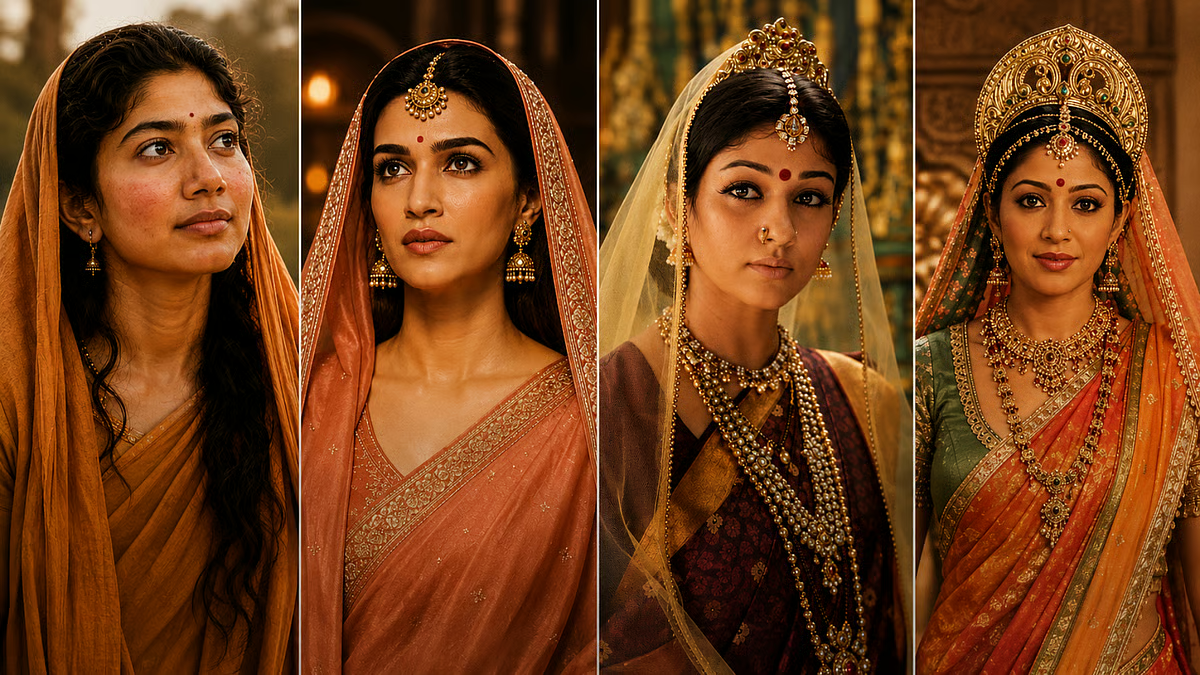
Sai Pallavi as Sita was suddenly no longer considered beautiful. Her features were suddenly deemed ‘unnatural’ and her appearance ‘culturally inappropriate’ for the role of Janaka’s princess. Her features were dissected, and her casting in the film was heavily criticised on social media. Rakul Preet Singh, who plays Soorpanaka, was described as a beauty who could “eat 50 Sai Pallavis for breakfast”. Discussions ranged from “How could Sita have curly hair?”, “Why was a South Indian cast as Sita?”, “Why is Soorpanaka looking more beautiful than Sita” to “Why is an anti-national cast as Maa Sita?” Worse, Sai Pallavi was compared to actor Surabhi Das (who briefly appears as her on-screen sister Shrutakirti in the trailer), triggering comments that Surabhi was a better fit for Sita.
The criticisms reached a pinnacle when she was ranked “absolute trash” by users in comparison to Dipika Chikhlia, Nayanthara, Debina Bonnerjee and Kriti Sanon who played the character in various adaptations of the epic. The “ideal beauty” became one of the most-hated actors overnight in a debate surrounding a mythological character.
In a span of a few years, Sai Pallavi—once praised for her natural features—was dismissed the moment conventional beauty standards came into the picture. Their defense? Scriptures had repeatedly described Sita as the “epitome of beauty”, and she did not fit the bill. But what we should instead be questioning is who gets to define beauty in a world where we are rarely offered a blueprint on who or what brings meaning to the word, especially in an ever-evolving landscape.
History’s most celebrated women rarely fit into a rigid, cookie-cutter formula; instead, they were remembered for their charm, intellect, and cultural impact. Egyptian queen Cleopatra—whose true appearance remains a mystery—reportedly had an aquiline nose, a strong jawline, and a pointed chin, features that do not align with modern commercial glamour. So did Helen of Troy, whose recent depiction as black woman in The Odyssey sparked similar hate comments for Christopher Nolan and actor Lupita Nyong’o. Helen has no factual historical appearance; classical epics describe her as the daughter of Leda and Zeus, who took the form of a swan. The underlying logic fails to stand up to scrutiny.