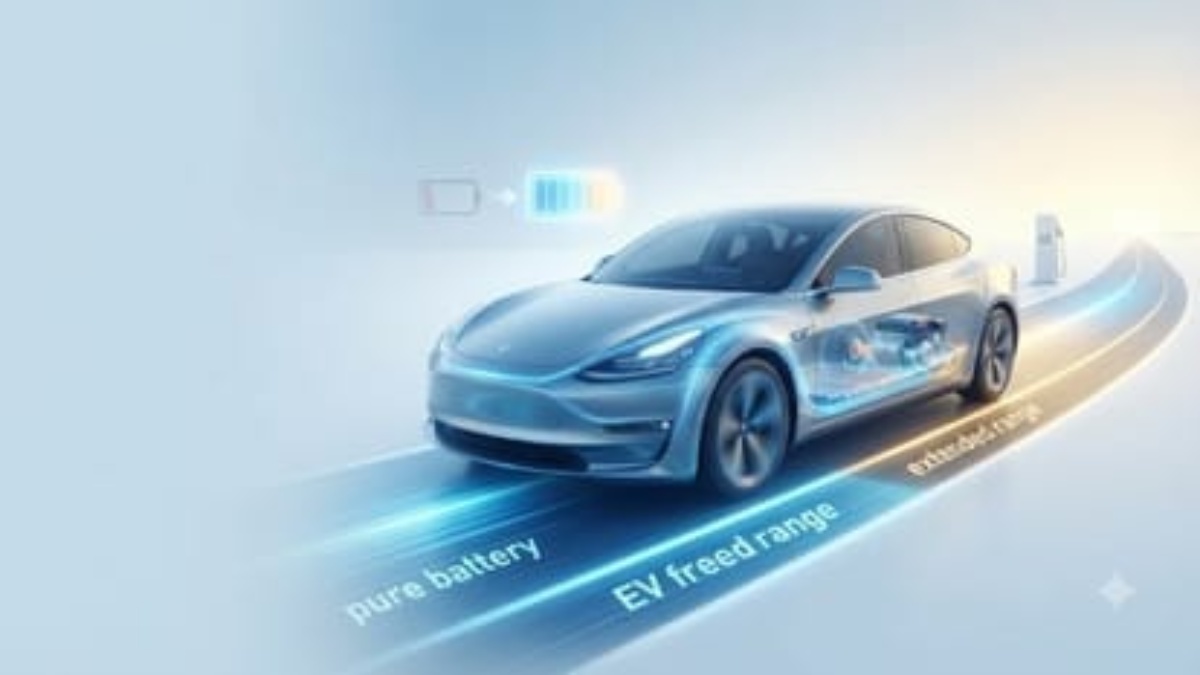
Automobile Desk – Customer interest in electric vehicles (EVs) is continuously increasing in the Indian automobile market. The number of EVs on the roads may be increasing, but the lack of robust charging infrastructure on highways and in remote areas still remains a major issue. The fear of running out of charge before setting out on a long trip—known in technical terms as 'range anxiety'—holds many potential buyers from purchasing an electric vehicle. To solve this practical challenge, auto companies are now focusing on Range Extender Electric Vehicle (REEV) technology.
Basically REEV is an electric car, inside which a small petrol engine acts as a backup generator. The biggest feature of this system is its power-train design. Unlike traditional petrol or hybrid vehicles, the engine does not directly provide power to the wheels. The wheels of the vehicle rotate only through the electric motor in all circumstances. As long as there is enough power in the battery, the vehicle runs in completely silent electric mode. As soon as the battery level goes below a certain limit, the petrol engine in it automatically starts and runs the generator, which generates electricity on-the-go and starts supplying it directly to the motor and battery.

People often confuse REEV with strong hybrid or plug-in hybrid (PHEV), although there is a big difference between the three at the technical level. In strong hybrids and PHEVs, the petrol engine also directly turns the wheels when needed. In REEV there is no direct mechanical connection of the petrol engine to the wheels; Its only work is to generate electricity. Additionally, compared to BEV (Pure Battery Electric Vehicle), REEV does not have to stop on the way for hours and look for a charging station when the battery is discharged. By refueling at a petrol station within 2 minutes, the journey can be continued without any interruption.
In the current scenario of India, this technology can act as a practical bridge. For short daily routes in metro cities, it can be charged at home with a normal charger and driven like a pure electric car. Whereas on interstate trips or on the highway, the petrol generator takes over as a backup. According to experts, with this setup the total driving range of the vehicle can reach more than 1,000 kilometers, which is much higher than any ordinary BEV at present.
However, REEV's path in the Indian market has not been entirely smooth. Apart from the battery pack and electric motor, all these components – petrol engine, fuel tank and generator – are present together in the car. This makes the manufacturing structure of the vehicle quite complex, which is bound to increase its initial manufacturing cost. Apart from this, what will be the government subsidies and tax slabs available to this technology in India will also play an important role in its success. If companies are able to offer it at the right price, it could emerge as a perfect option for customers who want the benefits of an EV but want to avoid the uncertainty of the charging network.